
Hypersonic Trajectory Variables
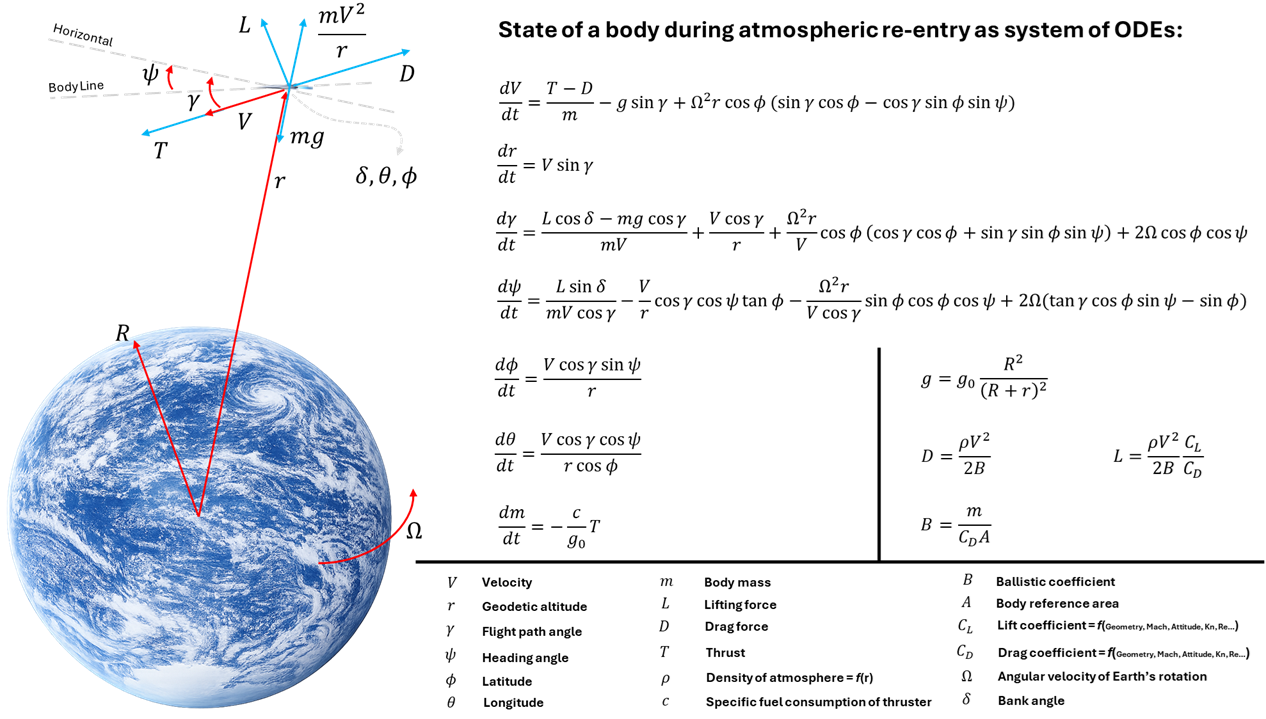
The trajectory of a hypersonic vehicle is often constrained by the integral and peak aerothermal loads experienced during flight. Refining the trajectory directly influences how uncertainties in aerothermal loads are resolved.
A coupled system of ODEs (shown in the figure) describes how the state of a re-entry vehicle evolves with time, which is, in essence, its trajectory. The governing equations are written in terms of six state variables: velocity, geodetic altitude, flight path angle, heading angle, latitude, and longitude. During powered phases, the rate of fuel mass loss also affects the vehicle dynamics. These nonlinear ODEs are typically solved using higher-order numerical schemes.
3-DoF trajectory model and aerothermal load
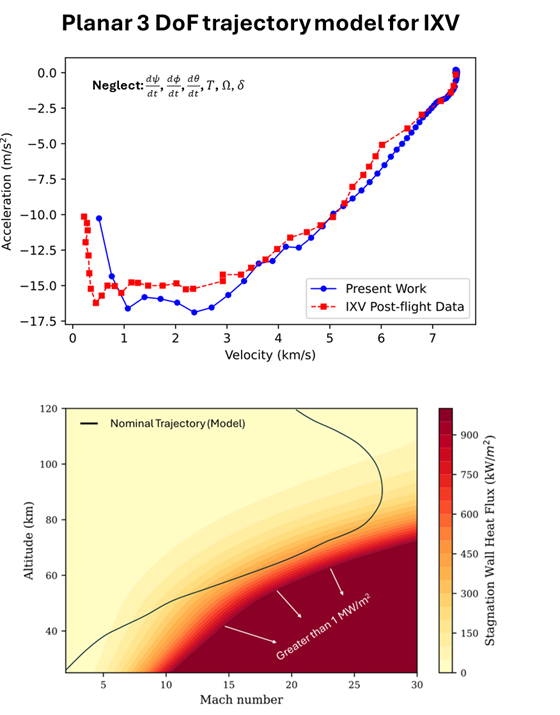
For early design studies and rapid optimization, the full system can be simplified by introducing physically consistent assumptions. By neglecting the rate of change of latitude, longitude, and heading angle - along with Earth’s rotation, bank angle, and thrust - the system reduces to a 3-DoF model governed by velocity, geodetic altitude, and flight path angle. In hypersonic regimes, if the angle of attack remains fixed, CL and CD often vary weakly with Mach number over limited bands, allowing them to be approximated as constants for preliminary studies.
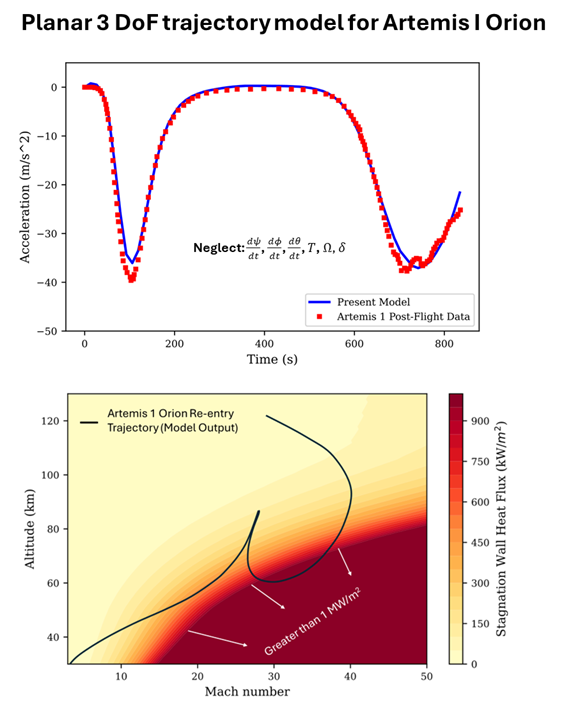
Such a planar 3-DoF model was used to predict the re-entry of IXV and Artemis I Orion, as shown in the figures. The rate of change of velocity was predicted using altitude profile and atmospheric model as input, and the system was integrated using a 4th-order Runge–Kutta scheme, as described in our recently accepted AIAA JSR paper (https://lnkd.in/eMXgGJb3).
Even with these assumptions, the acceleration and Mach histories were captured reasonably well, demonstrating that reduced-order models can support trajectory design and aerothermal constraint studies in early phases.
Further simplifications
Ballistic re-entry for highly blunt geometries (CL/CD ~ 0)
Shallow entry for peak deceleration and heating estimates (flight path angle near zero)
Equilibrium glide for lifting re-entry vehicles (rate of change of flight path angle ~ 0)
Uncertainties in parameters including but not limited to CL, CD, rarefied effects (Knudsen number), thrust modeling, atmospheric density models, geodetic altitude definitions, and chosen numerical scheme can propagate into trajectory prediction errors. The structure of the ODEs remains clean; however, the inputs/scheme carry the uncertainty.
Reference : Josselyn, S., & Ross, I. M. (2003). "Rapid verification method for the trajectory optimization of reentry vehicles". Journal of Guidance, Control, and Dynamics, 26(3), 505-508.
